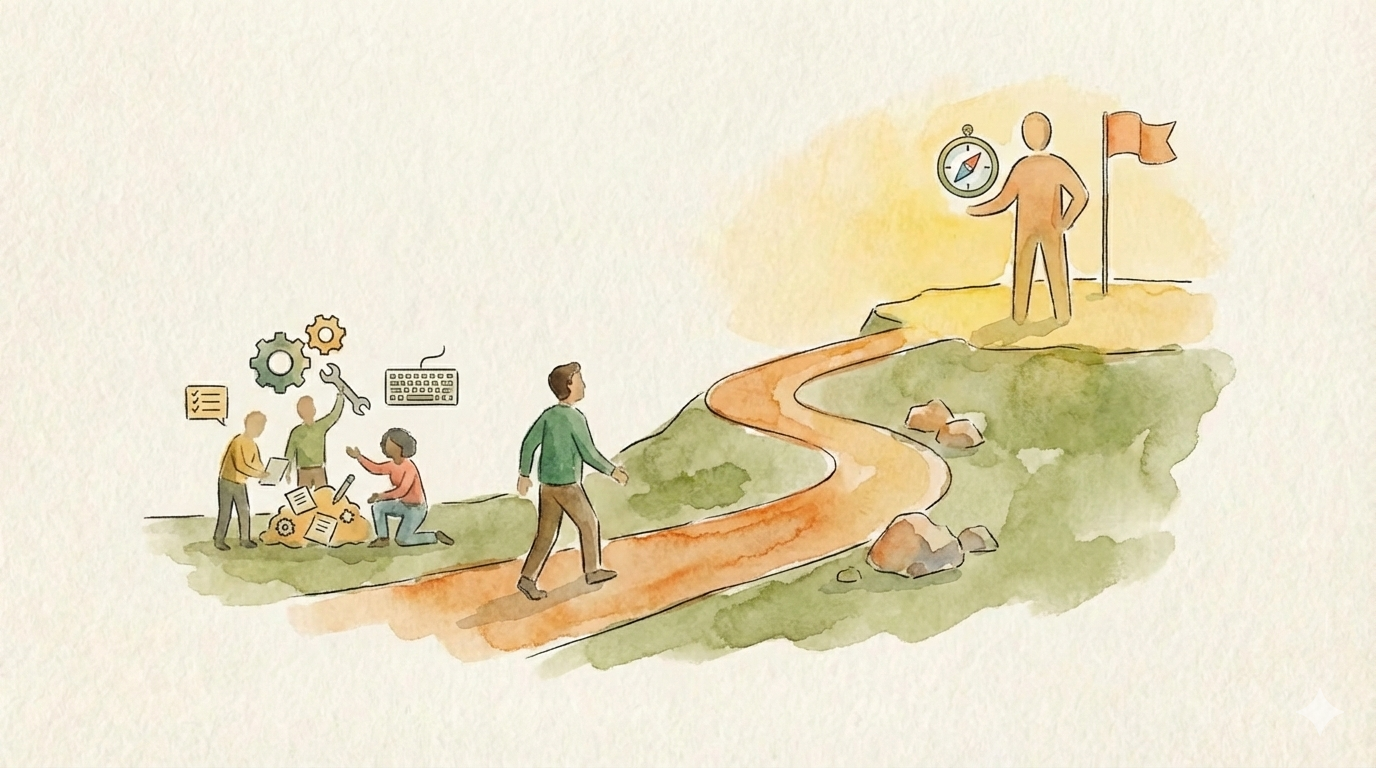
Nobody would have thought that the hardest part of becoming a team lead wasn’t the leading — it was the becoming.
When I made the switch from senior engineer to team lead, I somehow expected a clean break. Old role ends on Friday, new role starts on Monday. In hindsight that was naive. In reality, the transition stretched over months. And during that time, I was stuck in a no man’s land that was more exhausting than the team lead role itself.
You Don’t Get to Just Stop
Here’s what can be easily overlooked: when you become a team lead, your old responsibilities don’t disappear. You’re still the person who knows how the authentication service works. You’re still the one who owns that migration project that’s halfway done. You’re still the go-to for that one critical integration nobody else has touched.
Your calendar starts filling with meetings and planning sessions, but the colleagues keep coming to your desk: “Hey, can you take a quick look at this PR?” and “We’re stuck on that caching issue, do you have five minutes?” Five minutes turns into two hours, and suddenly you’re doing two jobs at once while excelling at neither.
The transition isn’t a switch you flip. It’s a slow, deliberate handover of everything you’ve built up over the years — projects, knowledge, ownership. And that handover takes real effort and maybe also help from other willing to take over. You need to document things you’ve only kept in your head. You need to pair with teammates on systems you used to maintain alone. You need to actively resist the pull of familiar, comfortable work.
The Mindset Shift Is the Real Challenge
Letting go of projects is one thing. Letting go of your identity as the person who builds things is another.
For years, my value was tied to what I shipped. I solved hard problems. I wrote elegant code. I had opinions about architecture, and those opinions were good (at least I was told). That felt great.
As a team lead, your job is no longer to have the best ideas — it’s to create an environment where your team can have theirs. And that means holding yourself back when you see a solution that is “obviously” better. It means watching someone take three days on a problem you could’ve solved in one, and recognizing that the learning they gain matters more than the time saved.
This was the hardest adjustment for me and took quite some time. I’d be in design discussions, and my brain would immediately jump to implementation details. I had to teach myself to ask questions instead of giving answers. “What tradeoffs did you consider?” is more valuable from a team lead than “Here’s how I’d do it.”
Pushing your ideas too hard doesn’t just slow your team’s growth — it teaches them to wait for your input instead of developing their own judgment. And a team that depends on your technical decisions is a team you’ll never truly lead.
The Uncomfortable Middle
The worst part of the transition is the middle. You’re no longer contributing meaningfully as an engineer because you’re in meetings half the day. But you’re not yet effective as a team lead because you haven’t fully let go of your old responsibilities. You feel like you’re failing at everything.
This phase is normal. Luckily it was also temporary — but you need to be intentional about it. A few things that helped me:
Set explicit handover dates for your projects. Not “I’ll gradually step back,” but “By March 15th, Alex owns the billing service.” Put it on the calendar. Tell the team. Don’t be afraid to ask for help. Make it real.
Block time for lead work. If your day is still dominated by technical tasks, your transition isn’t happening. Protect time for 1-on-1s, roadmap thinking, and the unglamorous work of unblocking others.
Accept that your output will feel invisible for a while. You won’t have PRs to show. Your impact shows up in your team’s velocity, their confidence, and the problems that never escalate because you caught them early. That takes time to see — and even longer to feel proud of.
It Gets Better — Differently
Once you’re through the transition, being a team lead has its own rewards. Watching someone on your team crack a problem they would’ve escalated to you six months ago? That’s a different kind of satisfaction than shipping code, but it’s real.
The key insight is this: the transition period isn’t just logistics. It’s a fundamental rewiring of how you measure your own value. You go from “I built this” to “I enabled this.” And that shift — not the 1-on-1 templates or the sprint planning — is what makes or breaks a new team lead.
If you’re in the middle of this transition right now and it feels like you’re drowning: that’s not a sign you’re doing it wrong. It’s a sign you’re actually doing it.